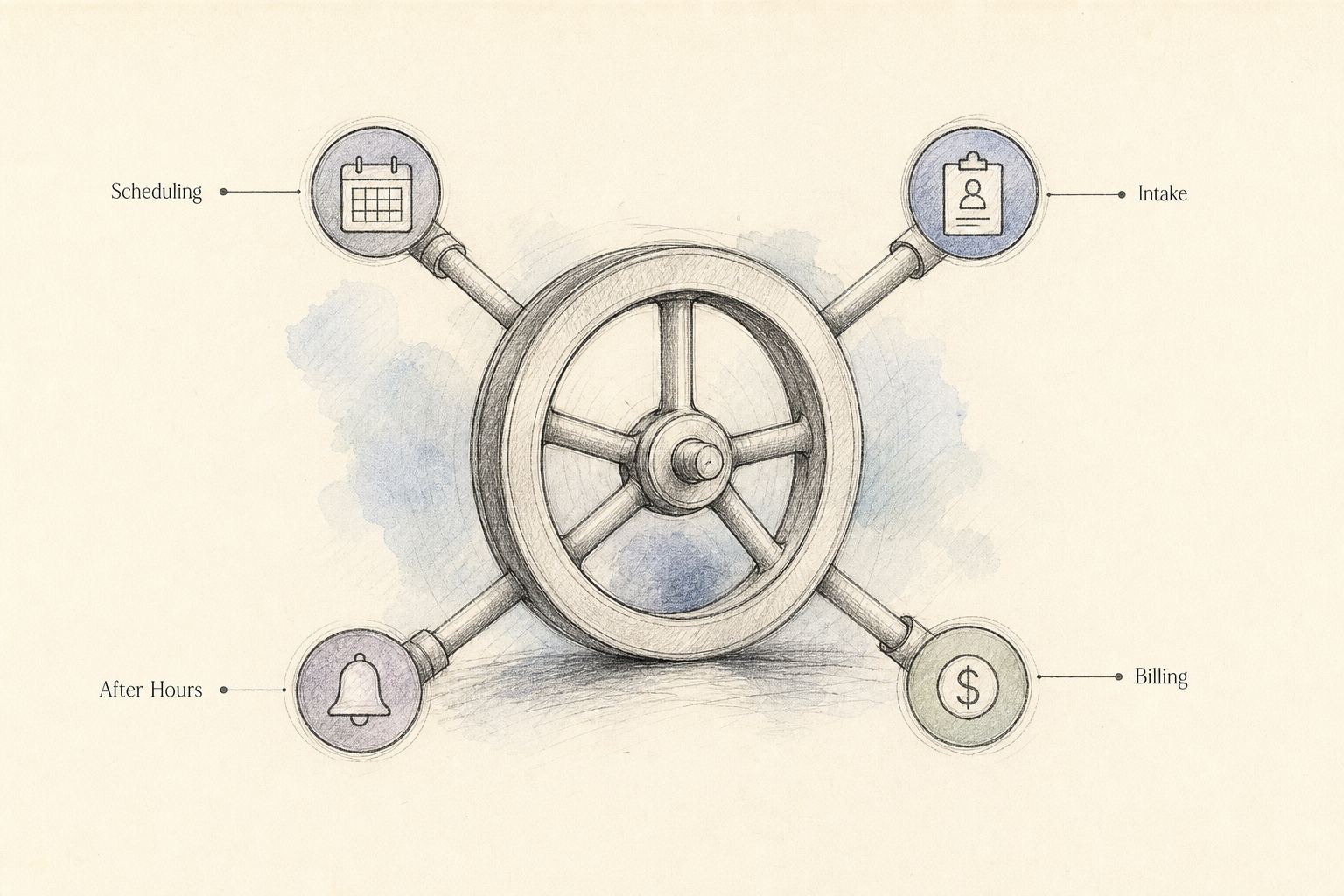
An AI receptionist is software that answers your practice’s phone and handles the request the way a front-desk staffer would. It can book the visit, pull up a referral, or route a refill. It runs 24/7, takes every call at once, and for a medical practice should connect straight into your EMR. Plans range from roughly $100 to $1,500+ a month.
Most tools sold as an "AI receptionist" are a scheduling bot with a phone number attached — they can book a slot, but they can’t touch a lab result, a referral, or a refill, because they were never wired into the EMR in the first place. That gap is the whole story of this category right now. A patient doesn’t call your office only to book. They call about a prescription, a bill, a test result, a symptom they’re worried about. A receptionist that only handles the calendar is solving a third of the problem and calling it done.
What does an AI receptionist do?
At the baseline, it picks up the phone before the third ring, every time, including nights and weekends. From there, the range of what it can do depends entirely on whether it’s connected to your practice management system and EMR or running only on its own calendar.
A connected AI receptionist can:
- Book, reschedule, and cancel real appointment slots in the EMR
- Answer refill and medication questions and route them to the right provider
- Check the status of a referral or a lab result and read it back to the patient
- Take billing and insurance questions
- Handle new-patient intake and registration
- Cover every after-hours and overflow call so nothing lands in a voicemail box
An unconnected one can usually only do the first item on that list. It reads from its own calendar, not your live schedule, so a double-booking or an outdated slot is common. Ask any vendor one question before you buy: does this write back to my EMR, or does it hold its own separate calendar?
Why most AI receptionists stall at scheduling
Scheduling is the easy part to build, so it’s where most vendors stop. A calendar API is a known problem. A live, two-way connection into Epic, athenahealth, or eClinicalWorks is a harder integration to build. It can read a referral status or write a refill request back to the chart, and it’s the one that matters most to your staff.
Without that connection, the "AI receptionist" does the same job as a message-taking answering service, only with a synthetic voice instead of a person writing a sticky note. Your staff still has to open the chart, confirm the request, and do the work by hand. You’ve automated the greeting, not the task.
The practices that get real relief from an AI receptionist are the ones that checked for EMR write-back before they signed. That single feature is the line between a phone tree with better manners and a front desk that runs itself.
AI receptionist vs. virtual receptionist vs. answering service
| Answering service | Human virtual receptionist | AI receptionist (EMR-connected) | |
|---|---|---|---|
| What it does | Takes a message | Answers and books | Answers, books, and updates the EMR |
| Hours | 24/7 (live) | Business hours or 24/7 | 24/7, unlimited calls at once |
| Resolves refills, labs, referrals | No | Occasionally | Yes, if connected to the EMR |
| Languages | Limited to staff on shift | Depends on staff | Every call, multiple languages |
| Cost model | Per minute or per call | Monthly or hourly | Flat monthly fee |
Not every practice needs the most automated option on this table. A single-provider office with light call volume might do fine with a human virtual receptionist. A busy multi-provider practice drowning in refill and billing calls is exactly the case an EMR-connected AI receptionist was built for. For more on the receptionist-vs-answering-service distinction, see what a virtual receptionist is and what an AI receptionist is.
How much does an AI receptionist cost?
Most medical-grade AI receptionists run $100 to $1,500+ a month, priced by call volume, the number of provider lines, and whether after-hours and multilingual coverage are included. That’s well under the fully loaded cost of a front-desk hire, which runs $55,000 to $75,000 a year before you account for the 30% to 40% annual turnover most practices see at the front desk (OmniMD; SHRM, via HealthTalk AI).
Compare quotes on the same basis: ask what’s included at the base tier and what triggers an overage — call volume caps and after-hours coverage are the two line items that most often turn a cheap quote into an expensive one. For the full pricing breakdown across service types, read how much an answering service costs.
How do I set up an AI receptionist for my practice?
Step 1: Map your real call volume
Pull a month of call logs if you have them. Your mix of scheduling, refill, billing, and clinical questions decides what capability you need.
Step 2: Confirm EMR compatibility
Ask for the specific integration, not a general "we support EHRs" answer. Get the vendor to name your EMR by system name.
Step 3: Test the after-hours and overflow handling
Call the demo line after hours. This is where message-only tools show their limits fastest.
Step 4: Check the compliance paperwork
Confirm a signed Business Associate Agreement is included, not an add-on. No BAA, no patient data.
Step 5: Run a 30-day pilot on one line
Route a single phone number to the AI receptionist before switching the whole practice. Watch what gets escalated to staff and why.
Is an AI receptionist HIPAA-compliant?
A medical-grade one is, but the label "HIPAA-compliant" isn’t automatic. Confirm it yourself. Look for a signed Business Associate Agreement, encrypted storage of any patient data the system touches, and staff-level access controls. A general-purpose AI receptionist built for law firms or contractors is not a safe fit for patient calls, no matter how well it schedules.
Does an AI receptionist replace my front desk?
For most practices, no — it replaces the phone as the bottleneck. Your staff still handles walk-ins, complex cases, and anything that needs a human judgment call. The AI receptionist takes the volume that used to eat their whole morning: routine bookings, refill requests, and the after-hours calls nobody was covering anyway.
Under a fee-for-service model, that’s a direct revenue story — every missed call is a booking that goes to the practice down the street. Under a value-based or capitated contract, the math shifts: a missed call isn’t lost visit revenue, it’s a member who skips a screening or ends up in the ER instead, and an avoidable ER visit runs roughly 12 times the cost of an office visit (UnitedHealth analysis via Fierce Healthcare). Either way, the call answered is worth more than the call missed.
Frequently asked questions
What is an AI receptionist?
An AI receptionist is software that answers your practice’s phone calls and handles the request, instead of recording a message. That can mean booking an appointment, checking a referral, or taking a refill request. The medical-grade versions connect to your EMR so the booking and the record match.
How much does an AI receptionist cost?
Most run $100 to $1,500+ a month for a medical practice, based on call volume, number of lines, and whether after-hours and multilingual coverage are included. That’s a fraction of the $55,000-plus fully loaded annual cost of one front-desk hire.
How do I build an AI receptionist for my practice?
You don’t build one from scratch — you configure a vendor’s platform to your practice: connect it to your EMR, set your call scripts and escalation rules, and pilot it on one phone line before switching the whole practice over. The setup steps above walk through it in order.
What is the best AI answering service for a medical practice?
The best fit depends on your call mix and your EMR. For a practice fielding mostly scheduling calls, a lighter tool may be enough. For a practice buried in refill, billing, and referral calls, look specifically for EMR write-back — that’s the feature that separates real resolution from message-taking with extra steps.
Is an AI receptionist the same as a virtual receptionist?
Not quite. "Virtual receptionist" can mean a live, off-site human or an AI system. "AI receptionist" specifically means the software version. The best AI receptionists for healthcare go further than either: they read and write in the EMR, which most human virtual receptionist services don’t do.
Does an AI receptionist work after hours?
Yes — this is one of its strongest use cases. It answers every call at the same speed at 2 a.m. as it does at 2 p.m., which is exactly when most answering services and human staff are unavailable or slow.