Ever wonder how many calls your clinic misses in a day?
For most patients, especially the elderly, calling remains the most preferred way to reach their doctor. But when the lines stay busy and no one is available to help, patients are left waiting or walking away.
Healthcare providers today manage a massive call load, often 13,000 to 15,000 calls a month. But with staff able to handle only 10–12 calls per hour, it’s impossible to keep up.
This results in long hold times, multiple callbacks, and unanswered calls. For the provider, that means missed appointments, disorganized schedules, and lost revenue opportunities.
For patients, it’s a frustrating experience that often leads to delays in care or unnecessary ER visits.
Meanwhile, front desk staff are flooded with routine queries and buried in manual documentation.
As the pressure builds, burnout and attrition rise, and service quality takes a hit. CSAT and CAHPS scores drop, and patient trust starts to erode.
It’s hurting both patients and the practice, through strained communication, lost time, declining satisfaction, and a growing gap between care demand and staff capacity.
In this blog, we’ll explore how AI medical receptionists are helping practices solve this long-standing challenge, and how VoxyHealth, a purpose-built AI medical receptionist, is leading the way.
9 Ways the AI Medical Receptionist Can Help Your Clinic
An AI medical receptionist is a voice agent that answers patient calls, gathers essential details, understands urgency, resolves routine queries, and books appointments, offering the reliability of a trained front desk staff with 24/7 availability.
1. Books Appointments
The AI Medical Receptionist can take complete control of appointment scheduling.
With 24/7 availability, patients no longer need to wait on hold or call only during business hours.
Patients calling for a first-time consultation or a routine check-up can be guided through a smooth booking process.
The AI medical receptionist pulls real-time availability and helps lock in the preferred slot instantly and without wait time.
No more staff interruptions or missed calls during peak hours. The AI ensures that every call gets answered, even after hours or during holidays.
Specialty Appointments:
Whether a patient needs a dermatologist, cardiologist, or a physiotherapist, the AI medical receptionist can classify the request and schedule based on specialty, provider availability, and urgency, especially when integrated with your EMR.
This routing reduces confusion for patients and front desk staff alike, ensuring everyone lands with the right provider at the right time.
EHR Sync:
The AI medical receptionist logs all appointment activity, bookings, updates, and cancellations directly into the clinic’s EHR system. This minimizes the risk of double-bookings, keeps provider schedules clean, and reduces manual data entry.
Your front desk team no longer needs to switch between systems or re-enter call details. Everything is synced in the background.
2. Assists in Patient Intake
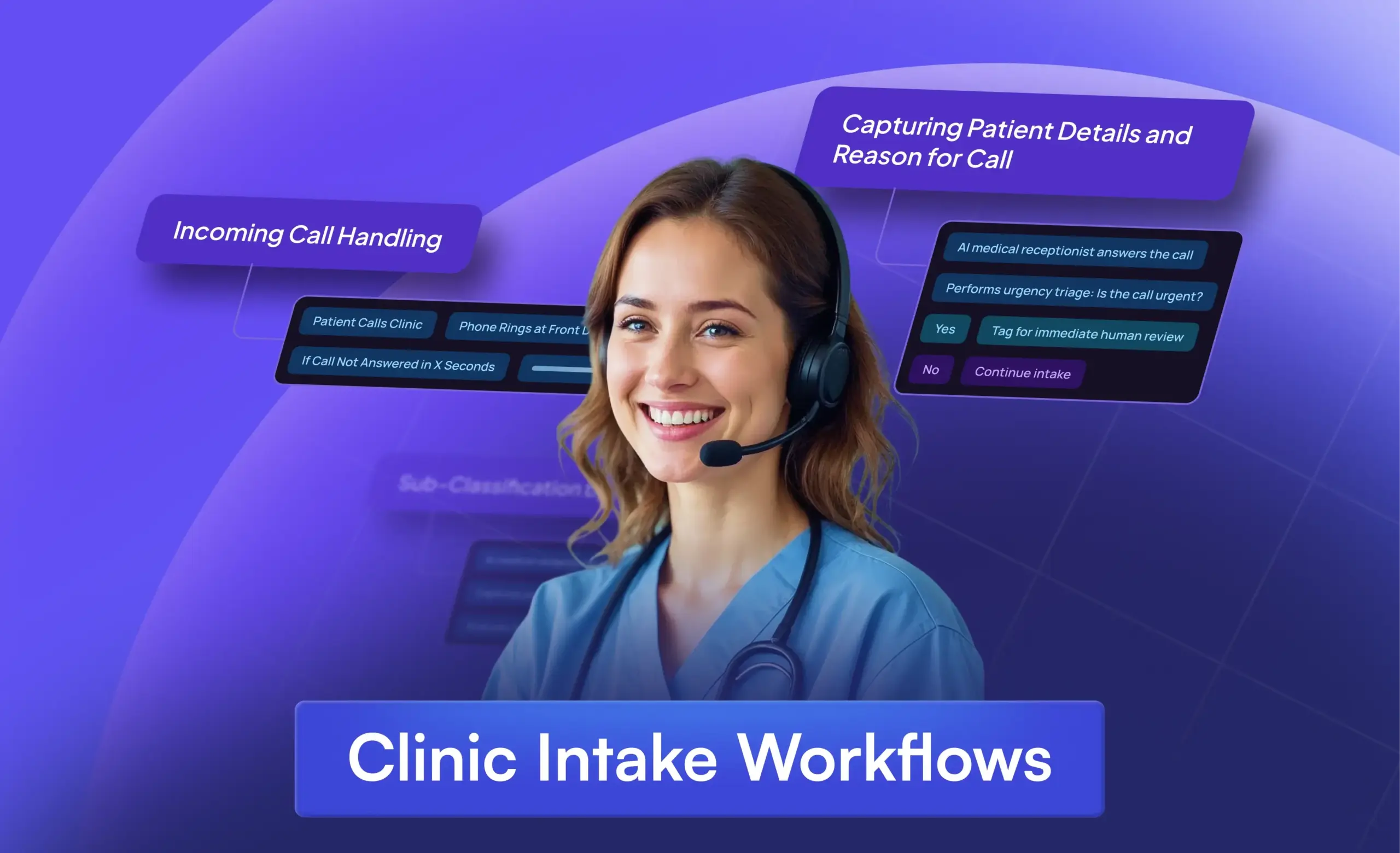
The AI Medical Receptionist collects intake information over a call, helping patients share symptoms, reason for visit, and level of urgency, all without needing a staff member to pick up the phone.
This approach reduces back-and-forth and captures key triage inputs upfront.
Collects Symptoms & Reason for Visit:
The AI Medical Receptionist can ask patients why they’re visiting and collect brief symptom descriptions in natural conversation.
Whether it’s “chest pain,” “sore throat,” or “follow-up for diabetes,” the system can flag these inputs for the provider’s review.
This ensures providers get context-rich notes ahead of time.
Can Assess Urgency for Triage:
When a patient reports symptoms like severe pain or sudden changes in health, the AI Medical Receptionist can route the conversation accordingly, escalating urgent cases and flagging them to human staff.
This triage ensures critical cases don’t get delayed in the queue and helps optimize clinical priorities.
Structured Handover to EHR:
All collected details, symptoms, reason for visit, and urgency level are logged and sent to the EHR or provider inbox in a structured format.
This reduces intake delays during in-person visits and allows healthcare providers to walk into the room with context already in hand.
3. Conducts Wellness Check-ins
The AI medical receptionist doesn’t just wait for patients to call; it can proactively reach out.
Outbound calls are made for wellness check-ins, recovery monitoring, and post-visit surveys, helping clinics maintain ongoing relationships with their patients.
Proactive Outbound Calls:
The AI Medical Receptionist can automatically call patients after a visit or procedure to check on their recovery progress. It asks the right questions, captures responses, and flags any issues for follow-up.
This replaces tedious manual follow-up calls and ensures that post-care monitoring doesn’t slip through the cracks.
When a patient cancels, the AI medical receptionist follows up to offer rescheduling options.
The system adheres to your clinic’s SLAs around cancellations or late changes and updates the calendar in real time.
Conducts Surveys & Monitors Recovery:
The AI Medical Receptionist conducts quick wellness surveys to gather feedback on pain levels, medication effects, or general health.
Based on responses, it can either end the call or escalate to a human team member.
It offers a scalable way to keep patients engaged between visits and gather information without increasing staff workload.
4. Handles Prescription Refill Requests
Patients frequently call when they’re about to run out of medication. The AI Medical Receptionist can handle these calls autonomously, logging refill requests and routing them to the appropriate provider or pharmacy workflow.
When a patient says, “I’m about to run out of my blood pressure meds,” the AI captures relevant details and routes the request into the right queue.
This prevents medication gaps while saving your front desk from routine, time-consuming refill calls.
5. Manages Insurance Claims & Billing
The AI Medical Receptionist can also support your front desk with insurance and billing-related tasks.
Patient concerns about denied claims, billing errors, or overcharges are captured and directed to the appropriate team when needed.
This helps resolve billing disputes promptly, reduces time spent on follow-ups, and increases patient satisfaction.
Insurance details are collected and logged directly into the EHR, reducing manual work and keeping records accurate.
This ensures patients aren’t left confused or waiting, and your staff can focus on resolving more complex issues.
6. Takes Care of Documentation and Records Requests
Handling requests for reports, medical forms, or patient records can be time-consuming. The AI Medical Receptionist ensures that everything is transferred efficiently.
When patients request a medical report or a form, the AI can record their request, understand the type of document needed, and deliver it without human intervention.
This ensures faster delivery of records, especially for time-sensitive requests.
The AI Medical Receptionist can help share medical history with patients or even external healthcare providers, ensuring that sensitive data is delivered in a compliant and secure manner.
This not only saves time but also makes documentation-sharing more efficient.
By logging documentation requests directly into the EHR, the AI keeps patient records up-to-date and free from errors.
This guarantees that patient data is consistent and easily accessible across the board.
7. Processes Referral Requests
The AI Medical Receptionist can handle all aspects of patient referral requests, from triaging the referral type to assessing urgency and facilitating the next steps.
Triages Referral Types:
The AI can assess whether a patient needs a referral to a specialist, another department, or a different facility. It gathers the required details and ensures the referral process is efficient.
Patients don’t have to wait for an office visit to get a referral; this speeds up the overall process.
Prioritizes Urgency for Referrals:
By evaluating the urgency of the referral, the AI Medical Receptionist ensures that critical cases are immediately flagged and escalated to the appropriate department or human staff member.
This ensures that no urgent referrals are missed and patients get the care they need as quickly as possible.
8. Proactive Post-Care Engagement
After a patient’s visit, follow-up communication is crucial. The AI Receptionist takes care of post-care engagement by sending reminders, collecting survey responses, and providing ongoing monitoring.
Check-ins & Reminders:
The AI Medical Receptionist makes automated follow-up calls to remind patients of upcoming appointments, necessary health check-ins, or routine tests.
This eliminates manual follow-up calls and ensures patients remember important care milestones.
Collects Surveys & Feedback:
After a visit, the AI can send out surveys to gather feedback on patient experience, treatment effectiveness, and recovery.
This provides your clinic with insights into patient satisfaction, helping you improve care quality.
It offers a more proactive approach to care, without increasing staff workload.
9. Answers Patient Questions
Patients often call to inquire about lab results, upcoming appointments, or clinical concerns. The AI Medical Receptionist can answer these queries promptly, providing instant support and reducing front desk interruptions.
Answers Lab Results Inquiries:
When a patient calls asking about lab results, the AI Medical Receptionist can access the relevant data and provide them with the information, depending on your clinic's protocol.
It can also inform patients whether their results are ready or still being processed by pulling updates from the EHR. This helps keep the communication flow clear and timely, reducing patient anxiety over waiting.
Appointment Information:
Patients frequently call to confirm appointment times or reschedule. The AI can check schedules, update appointments, and answer common questions about location, timing, or prep instructions.
Patients get instant answers, reducing the burden on staff and improving patient satisfaction.
Why Choose VoxyHealth
Our AI medical receptionist answers every patient call instantly, 24/7, with no wait times, no missed calls. It captures caller details, assesses urgency, and routes or resolves each request.
It books appointments, updates calendars, and logs interactions directly into your EMR. Patients speak naturally, while staff save time on repetitive scheduling tasks.
When human input is needed, our AI medical receptionist escalates the call with full context for faster resolution. This ensures smooth handoffs and high-quality patient service without overburdening staff.
The AI medical receptionist also makes outbound calls for follow-ups, reminders, wellness check-ins, and surveys.
Conclusion
Let’s face it, no one enjoys missed calls, long hold times, or overworked staff.
That’s where our AI medical receptionist steps in.
VoxyHealth brings clarity and speed to your front desk operations. With every patient call answered instantly, key details captured in real time, and urgent matters escalated seamlessly, you can trust that no interaction slips through the cracks.
It works around the clock, booking appointments, updating records, and communicating with patients, just like a trained front desk assistant, but always available.
Backed by EHR integration and intelligent workflows, VoxyHealth helps your team focus on high-impact care, not administrative overload.
The result? Faster response times, smoother patient experiences, and a more efficient clinic.
Ready to reimagine your patient communication?
Book a demo today.